

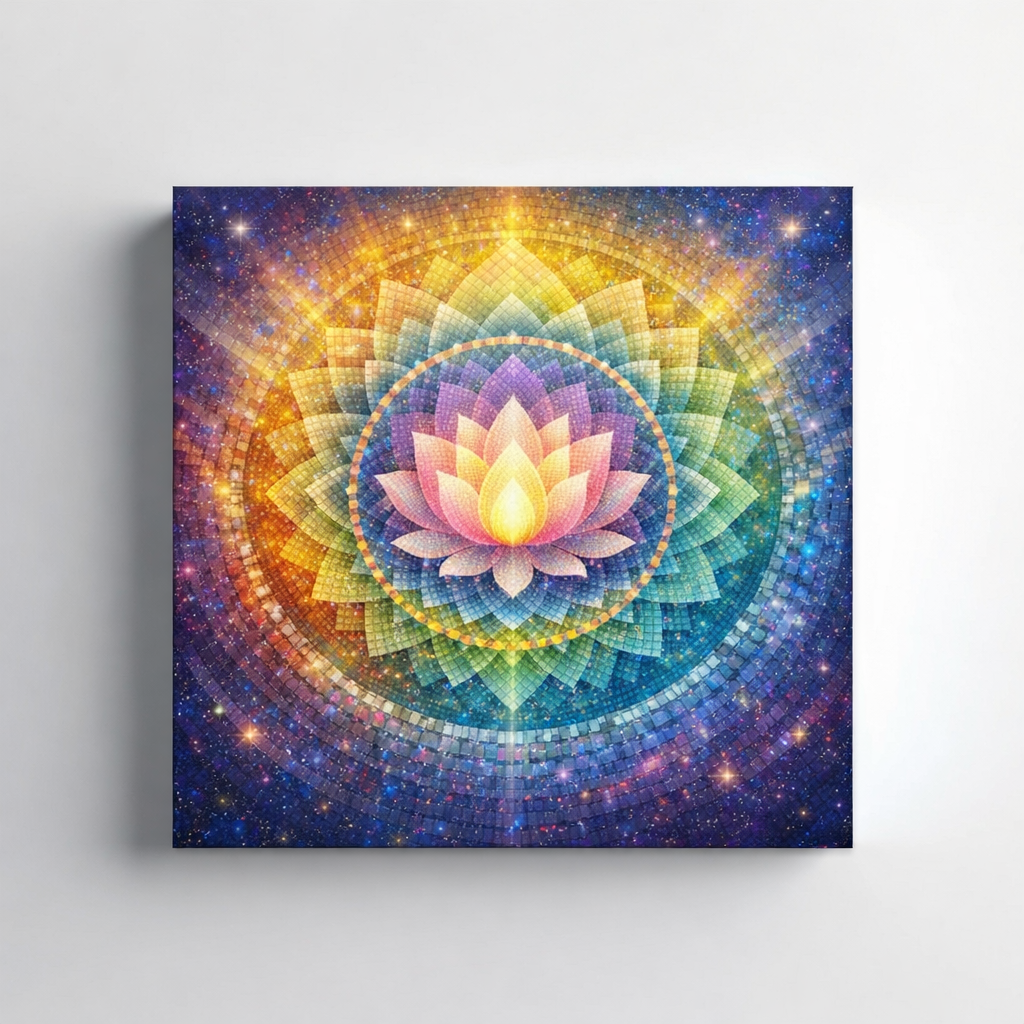
The Neuroscience Behind Digital Art Therapy
In a hyper-digital world, our brains are almost never truly offline. Endless notifications, short-form videos, and constant information streams keep our attention systems in a state of continuous activation. The result is familiar: reduced focus, rising anxiety, and persistent mental fatigue.
Visual rest is not a poetic metaphor—it is a neurobiological necessity. Digital art therapy has emerged as an effective tool precisely because it aligns with how the brain naturally recovers.
1. The Real Problem: Prefrontal Cortex Overload
The prefrontal cortex governs executive functions such as decision-making, self-control, and sustained attention. In modern digital environments, it is chronically overstimulated.
This often manifests as:
- Difficulty concentrating
- Decision fatigue
- Heightened baseline anxiety
Key insight: True recovery does not require “stopping visual input.” It requires reducing cognitive demand while vision remains engaged.
2. Flow State: Focus Without Mental Strain
The flow state is often misunderstood as passive relaxation. In reality, it is a condition of deep focus combined with low self-monitoring.
Neuroscientifically, flow is associated with temporary downregulation of prefrontal activity (sometimes called transient hypofrontality). This allows the brain to shift from control-heavy processing to immersive perception.
The mind is engaged—but no longer tense.
3. Why Spirals and Mandalas Work So Well
Visual Anchors and Attention Stabilization
Spirals, mandalas, and sacred geometry share three critical properties:
- High structural order → Low prediction cost for the brain
- Moderate complexity → Engaging without overload
- Central or circular symmetry → Naturally stabilizes gaze
These features create a visual anchor—a focal point that gently holds attention without requiring conscious effort.
From Information Processing to Perceptual Resonance
Unlike scrolling feeds or text-heavy content, abstract digital art minimizes semantic decoding. The brain shifts toward processing shape, rhythm, symmetry, and pattern, which significantly lowers cognitive load.
This is one reason anxiety levels often drop within minutes.
4. How Digital Art Therapy Reduces Anxiety — Step by Step
The mechanism can be summarized clearly:
- Stable gaze → Reduced visual scanning
- Lower prediction demand → Less cognitive strain
- Prefrontal inhibition → Decreased self-monitoring
- Early flow state entry → Rapid emotional regulation
This explains the common experience of “sudden calm” during short sessions of visual meditation art.
5. How to Practice Visual Rest Using Digital Art
Practical, immediately usable guidelines:
- 1–2 sessions per day, 3–7 minutes each
- Choose abstract, non-narrative digital art (no text, no story)
- Maintain a fixed viewing distance
- Do not analyze—simply observe
Ideal use cases:
- Between intense work sessions
- 30 minutes before sleep
- Before creative or high-stakes decision-making
6. Not a Trend—A Cognitive Regulation Tool
Digital art therapy is not a replacement for clinical treatment. However, as a low-cost, low-friction method for attention recovery and emotional regulation, it is remarkably effective—and widely underestimated.
In an era where attention is constantly drained, learning to give your brain something visually engaging but cognitively effortless is a sophisticated form of self-care.
Integrated long-tail keywords:
Digital art for anxiety relief · Visual meditation tools · Flow state triggers
If you want, I can adapt this article into:
- A short-form thought leadership post
- A product landing page for digital meditation art
- A neuroscience-backed explainer for collectors or high-pressure professionals